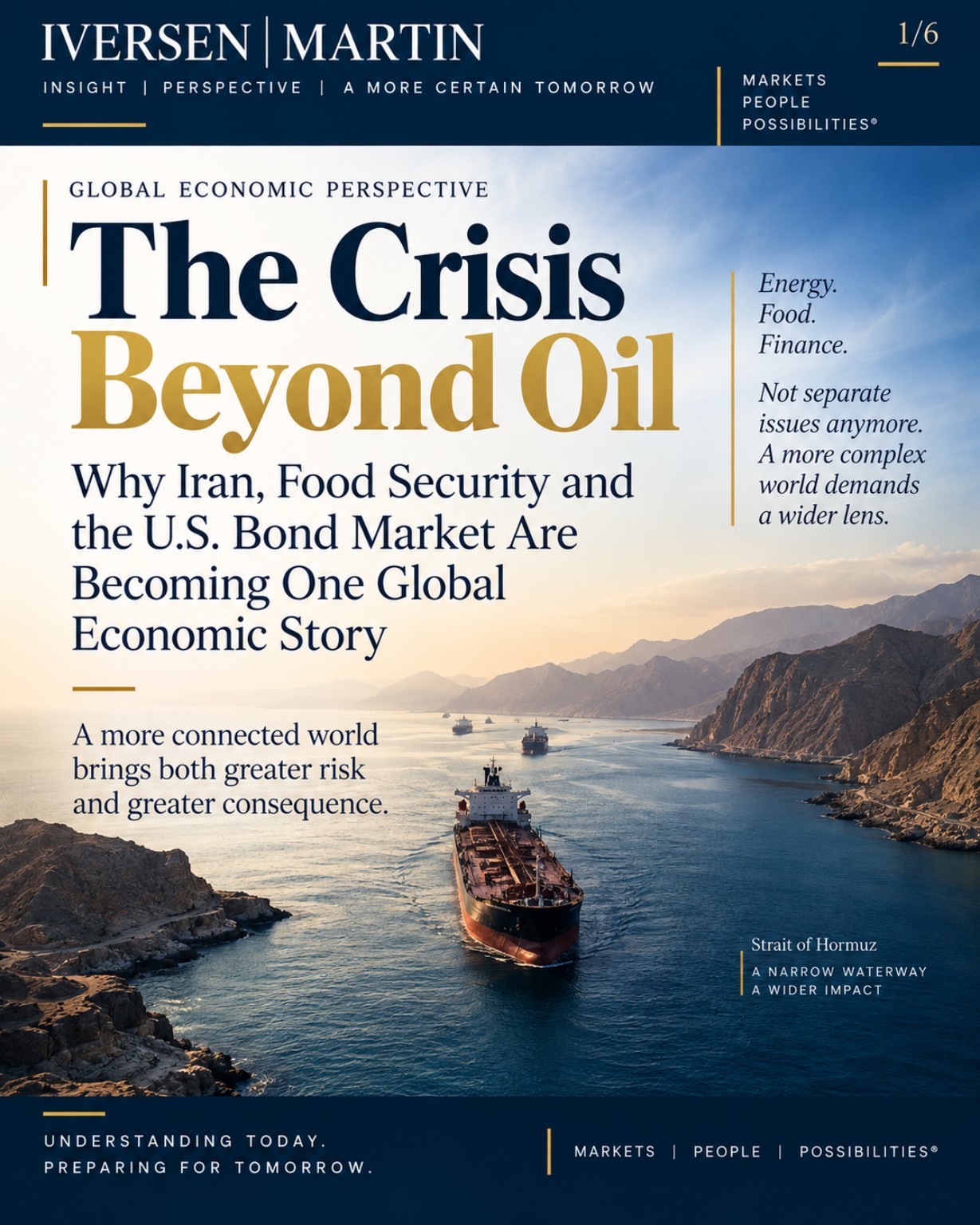
A disruption in the Strait of Hormuz can travel from energy markets to fertilizer, harvests, food prices, interest rates and sovereign balance sheets. The central risk is not one isolated shock, but several interconnected pressures arriving at the same time.
In this perspective
- Introduction
- The Strait of Hormuz Is Also a Food Chokepoint
- The Next Food Crisis May Begin With Inputs, Not Empty Silos
- Then Comes the Bond Market
- Where Iran and the Bond Market Meet
- What 5 Percent Treasuries Mean on Main Street
- The Rest of the World May Be More Vulnerable Than America
- Is the World Losing Confidence in America
- What Can Be Done
- The Larger Lesson
- Sources and Notes
Introduction
Most discussions about the economic consequences of the war in Iran begin with oil. That is understandable. The Strait of Hormuz is one of the most important energy corridors in the world. Disruption there immediately affects crude oil, liquefied natural gas, shipping, insurance and transportation costs. Those effects quickly reach businesses and households through gasoline, diesel, electricity and the cost of moving goods.
But focusing exclusively on oil risks missing a much larger economic story. What passes through the Persian Gulf is not simply energy. The region is deeply embedded in the global agricultural supply chain, particularly through fertilizers and the raw materials required to produce them.
At the same time, this supply shock is arriving during an unusually sensitive period for global financial markets. U.S. Treasury yields have moved sharply higher, the United States is financing historically large amounts of debt, and governments around the world are confronting elevated borrowing costs. These are not independent problems. They increasingly interact with one another.
Understanding that interaction may be more important than trying to predict tomorrow's price of oil.
The Strait of Hormuz Is Also a Food Chokepoint
Under normal conditions, the Strait of Hormuz carries a major share of internationally traded crude oil and LNG, as well as a substantial share of globally traded fertilizer and fertilizer feedstocks. That agricultural dimension deserves considerably more attention than it receives.
Modern agriculture depends heavily upon nitrogen, phosphate and potash fertilizers. Natural gas is a critical feedstock in the manufacture of ammonia, which in turn is the foundation of most nitrogen fertilizer. Sulfur is important to phosphate fertilizer production. Energy therefore appears at multiple points in the agricultural equation.
A prolonged disruption in the Persian Gulf can simultaneously increase the cost of producing fertilizer, restrict its physical availability and raise the cost of transporting it to farmers. The Food and Agriculture Organization has warned that fertilizer scarcity associated with disruption in Hormuz can affect harvests during the latter half of 2026 and into 2027.
This is where the economic impact becomes delayed and potentially deceptive. A shortage of oil is visible almost immediately. The price at the gasoline pump changes within days. A fertilizer shortage behaves differently because agriculture operates according to biological calendars. If fertilizer is unavailable or prohibitively expensive during the correct application window, a farmer may use less, change crops, reduce acreage or accept lower expected yields.
The transmission mechanism is straightforward: energy disruption leads to fertilizer disruption; fertilizer disruption raises agricultural input costs; higher input costs can reduce fertilizer application; lower application can reduce potential yields; tighter grain supplies raise feed costs; and higher feed costs place pressure on meat, dairy and processed-food prices.
Fertilizer is only one pathway. Agriculture requires diesel for tractors and harvesters, energy for irrigation, fuel for transportation, electricity for refrigeration and processing, petrochemicals for packaging, and substantial logistical infrastructure to move products from farms to consumers. The same geopolitical event can therefore strike the food system repeatedly.
The Next Food Crisis May Begin With Inputs, Not Empty Silos
There is an important distinction between the present situation and the food shock following Russia's invasion of Ukraine. Russia and Ukraine are major agricultural exporters, so that disruption directly threatened the movement of wheat, corn, sunflower oil and fertilizer.
The Persian Gulf represents a different vulnerability. Rather than removing enormous quantities of grain directly from world markets, a prolonged Gulf disruption threatens some of the inputs that allow farmers elsewhere to produce that grain efficiently. This is potentially a production shock with a time delay.
A farmer facing substantially higher fertilizer prices does not necessarily stop producing. The more likely response is economic optimization: apply less fertilizer, substitute where possible, shift acreage or reduce investment. Each decision may be rational on its own. Collectively, millions of those decisions can reduce global agricultural output.
The countries most vulnerable are not necessarily those geographically closest to Iran. Import-dependent economies in Africa, Asia and parts of the Middle East are especially exposed where governments and households have limited capacity to absorb higher food and energy prices. This is how a conflict concentrated around one narrow body of water can eventually affect dinner tables thousands of miles away.
Then Comes the Bond Market
As if that were not enough, the energy and agricultural shock is colliding with another problem: the world's most important government bond market is under significant pressure.
In mid-September, the yield on the benchmark 10-year U.S. Treasury moved above 5 percent. Rising Treasury yields matter because U.S. government securities form the foundation upon which enormous portions of global finance are priced. This is not merely something that affects bond traders. Treasury yields influence mortgages, corporate financing, commercial real estate, consumer credit and the cost of capital throughout the American economy.
There are several forces behind today's higher yields and they should not be reduced to one explanation. Large government borrowing requirements matter. Inflation expectations matter. The enormous capital requirements associated with technology and artificial-intelligence investment matter. Global bond-market conditions and geopolitical risk matter.
Economic strength and intense competition for capital can push long-term rates higher. At the same time, investors may require greater compensation to hold long-duration debt amid uncertainty about inflation, interest rates, issuance and fiscal conditions. Both realities can exist simultaneously.
Where Iran and the Bond Market Meet
The Iran conflict represents an external supply shock. Higher energy prices raise transportation and production costs. Fertilizer disruption increases agricultural costs. Eventually those pressures can reach consumer food prices and create additional inflation pressure.
Ordinarily, weakening economic activity gives central banks room to lower interest rates. An inflationary supply shock complicates that response. The Federal Reserve may find itself confronting two opposing forces: protecting economic activity and financial stability while preventing inflation from becoming entrenched.
The sequence is uncomfortable: Middle East disruption raises energy and agricultural costs; those costs create greater inflation pressure; inflation gives monetary policy less flexibility; elevated rates and bond yields increase borrowing costs; and higher borrowing costs slow economic activity.
The federal government is affected as well. As Treasury securities mature and are refinanced at higher interest rates, interest expense increases. Higher interest expense contributes to larger deficits, everything else being equal. Larger deficits require additional financing, and additional issuance must ultimately find buyers.
This does not mean the United States is experiencing a sovereign debt crisis in the conventional sense. Recent Treasury data still show substantial international demand for American financial assets. The concern is not that investors have suddenly abandoned the United States. The more useful question is what return investors will require to continue financing increasingly large quantities of American debt.
What 5 Percent Treasuries Mean on Main Street
For most Americans, the bond market seems remote until its effects arrive in everyday life. Higher Treasury yields influence mortgage rates, corporate loans, automobile financing, commercial real estate and business investment. Companies facing higher financing costs may delay expansion, reduce hiring or increase prices where markets permit.
Meanwhile, the Middle East supply shock attacks the household from another direction. Gasoline costs more. Diesel increases transportation costs. Transportation affects almost everything sitting on a store shelf. Higher fertilizer costs eventually affect food, while higher electricity and energy costs affect households and businesses.
The result is an unusual squeeze: the cost of living rises while the cost of borrowing rises with it. That combination is considerably more difficult for policymakers to address than a conventional recession.
The Rest of the World May Be More Vulnerable Than America
For all of America's problems, the United States retains enormous advantages. It is a major agricultural producer, produces substantial quantities of oil and natural gas, issues debt in its own currency, and possesses the world's deepest capital markets. Many developing economies have none of those advantages.
Consider an emerging economy dependent upon imported petroleum, fertilizer and food while carrying substantial dollar-denominated debt. It can be struck four times: oil becomes more expensive; fertilizer and food become more expensive; global borrowing costs increase; and a weaker local currency makes imports and dollar debt still more expensive.
Governments may then face an impossible choice among subsidizing food and fuel, supporting their currencies, servicing foreign debt and maintaining essential public services. Some of the most serious humanitarian consequences of the Iran conflict may eventually emerge nowhere near Iran.
Is the World Losing Confidence in America
That question deserves precision rather than rhetoric. There is not currently sufficient evidence to conclude that international investors have broadly lost confidence in the United States. The available capital-flow data do not support such a sweeping conclusion.
But something subtler deserves attention. Confidence does not have to disappear for financing conditions to deteriorate. Investors merely have to demand greater compensation for inflation risk, fiscal uncertainty, interest-rate risk and the opportunity cost of deploying capital elsewhere.
A Treasury yield above 5 percent therefore means something different depending on its cause. If yields rise because productivity and investment opportunities are exceptionally strong, that tells one story. If they rise because investors require greater compensation for inflation, fiscal or duration risk, that tells another. Today's market contains elements of both.
What Can Be Done
There is no single policy capable of resolving this combination of problems. The most effective response is to attack the vulnerabilities individually.
For food security, maintaining open trade in fertilizers and agricultural inputs is critical. Alternative transportation routes and suppliers become strategically important. Farmers need access to inputs during the narrow periods in which those inputs affect production. Avoiding export restrictions and protecting humanitarian food corridors can help prevent a supply shock from becoming a broader food emergency.
Over the longer term, diversification matters. Countries dependent upon a single region for fertilizer, energy or critical agricultural inputs have repeatedly learned that efficiency without redundancy can become extraordinarily expensive during a crisis.
For the United States, fiscal credibility matters. That does not mean abruptly eliminating deficits during an economic shock. It means demonstrating that the long-term relationship among spending, revenues, growth and debt is manageable. Markets do not require perfection. They require confidence that the arithmetic ultimately works.
Monetary policy faces the immediate challenge of distinguishing temporary supply-driven inflation from inflation becoming embedded in wages, prices and expectations. Households and businesses can respond by preserving liquidity, avoiding unnecessary exposure to variable financing costs, diversifying critical suppliers, and avoiding plans that depend on a rapid return to the unusually low interest rates of the previous decade.
The Larger Lesson
It is tempting to view the Iran war, oil prices, fertilizer shortages, food inflation, Treasury yields and government debt as separate stories. They are increasingly parts of the same story.
A disruption in the Strait of Hormuz can increase the price of energy. Energy affects fertilizer. Fertilizer affects agriculture. Agriculture affects food. Food and energy affect inflation. Inflation affects monetary policy. Monetary policy and inflation expectations affect bond yields. Bond yields affect governments, corporations and households. Because U.S. Treasuries sit at the center of the global financial architecture, changes in the American bond market influence the cost of capital around the world.
None of this guarantees a global food crisis, a U.S. debt crisis or a severe recession. Forecasting those outcomes as inevitable would go beyond the evidence. But the vulnerabilities are real, measurable and increasingly interconnected.
The greatest mistake may be waiting for empty supermarket shelves, collapsing bond markets or an official recession before recognizing the problem. Economic crises rarely begin where consumers eventually experience them. They begin upstream—in shipping lanes, commodity markets, planting decisions, balance sheets and the price of capital.
For businesses, investors and policymakers, the appropriate response is neither panic nor complacency. It is preparation. The most important economic story emerging from the Middle East may ultimately not be the price of a barrel of oil. It may be what that barrel of oil sets in motion.
Sources and Notes
Data and market references are current to September 17, 2026. This article is general economic analysis and is not investment advice.
1. Food and Agriculture Organization of the United Nations. Strait of Hormuz crisis: fertilizer scarcity will affect next harvests and food supplies. https://www.fao.org/newsroom/detail/strait-of-hormuz-crisis--fertilizer-scarcity-will-affect-next-harvests-and-food-supplies--fao-warns/
2. World Trade Organization. Data analysis on Gulf fertilizer exports and global trade exposure. https://www.wto.org/english/blogs_e/data_blog_e/blog_dta_10jul26_451_e.htm
3. U.S. Department of the Treasury. Treasury International Capital data released September 16, 2026. https://home.treasury.gov/news/press-releases/sb0631
4. Reuters. U.S. 10-year Treasury yield crosses 5 percent. https://www.reuters.com/business/us-10-year-yields-reach-5-highest-since-2023-2026-09-14/
5. Reuters. Global bond selloff, oil and rate expectations. https://www.reuters.com/world/europe/global-bond-selloff-pushes-10-year-us-yield-toward-5-oil-rate-hike-fears-2026-09-11/
6. Council on Foreign Relations. The shifting composition of Treasury buyers and the U.S. debt trajectory. https://www.cfr.org/articles/the-shifting-composition-of-treasury-buyers-threatens-to-worsen-the-u-s-debt-trajectory
7. FAO. Open agricultural-input trade and efficient fertilizer use. https://www.fao.org/newsroom/detail/fao-urges-open-trade-on-all-agricultural-inputs-and-efficient-fertilizer-use-amid-global-food-production-risks/en